
Product · 2022 - 2024
Premium Property Management
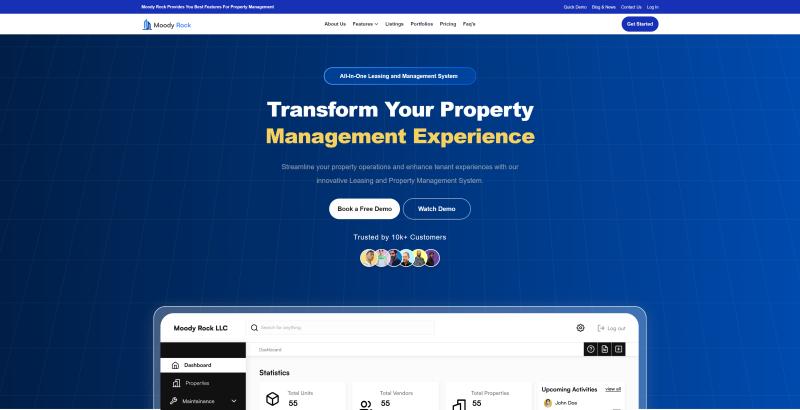
Case study on architecting a high-density property management platform with React, RTK Query, Next.js, and strict RBAC.
Archival Note: This application was developed as a client build. Due to client departure prior to commercial launch, live web addresses and source code repositories are archived and private. This case study focuses on technical leadership, frontend system design, and architectural decisions executed during development.
The problem with enterprise property platforms
Established property management systems like AppFolio offer extensive features, but their interfaces are notoriously congested. Navigation menus are overcrowded, operational workflows are buried, and day-to-day management tasks require navigating dense, unintuitive hierarchies.
The objective was to engineer a fast, clean alternative capable of supporting high-volume property operations without overwhelming the user. The platform required two separate web applications with distinct user flows:
- An Admin Operations Portal to manage assets, maintenance dispatches, service requests, vendor pay orders, tenant leases, and double-entry ledger accounts.
- A Multi-Tenant Portal allowing tenants to review lease agreements, initiate service requests, and process automated bill payments.
- A Public Marketing Platform designed to showcase features and convert prospective property managers with high-performance visuals.
System architecture and technical execution
As lead frontend engineer working alongside a co-lead, I directed frontend development while coordinating across a cross-functional team of backend engineers, QA testers, DevOps specialists, and designers. I authored 90 percent of the interface components and personally integrated all API communication channels across both applications.
Structured role-based access control. Built a rigid authorization flow using JWT tokens, React Context, and Redux Toolkit Query. This allowed the client app to resolve permission tiers dynamically, granting super-admins, property managers, maintenance vendors, and tenants access only to authorized routing branches.
Managed complex, high-density application state. Property management involves heavy data mutation across accounts, ledger items, and maintenance logs. I utilized Redux Toolkit Query for centralized caching, automated query invalidation, and background data synchronization. Form validation across data-dense views was standardized using Yup schemas.
Created lightweight custom UI modules. To prevent dependency bloat, I developed custom components in-house, including an embedded rich-text editor for email dispatching, customized data grids, and state-driven modal workflows.
Engineered CSS-driven landing animations. The public-facing site required animated UI elements to demonstrate platform capabilities. Rather than importing heavy animation packages like Framer Motion, I built custom keyframe sequences using TailwindCSS and inline SVG manipulation. This delivered fluid visual feedback while keeping the total JavaScript footprint minimal.
Standardized containerized environments. Worked with DevOps to implement Docker containers for local development and staging testing. This eliminated runtime discrepancies across team environments and simplified frontend deployment pipelines.
What was delivered
The development phase produced a production-ready frontend system that successfully passed all staging validation cycles and investor demonstrations.
- A modular Admin Panel that organized enterprise property management features into categorical workflows without interface clutter.
- A secure Tenant Portal providing isolated views for billing, lease tracking, and service management.
- A high-speed landing page built with Next.js and TailwindCSS, optimized for lighthouse performance through pure CSS and SVG animations.
Decoupling server state caching from local layout state allowed the admin interface to render thousands of property records cleanly without dropping frames during prolonged user sessions.
Technical takeaways
Leading the frontend engineering for this platform provided deep practical experience in enterprise system design, cross-functional project management, and state optimization. Designing strict state boundaries and avoiding unnecessary third-party packages proved essential for maintaining speed and predictability in large-scale web applications.